The way we word
How the Aussie vernacular has changed in my lifetime.

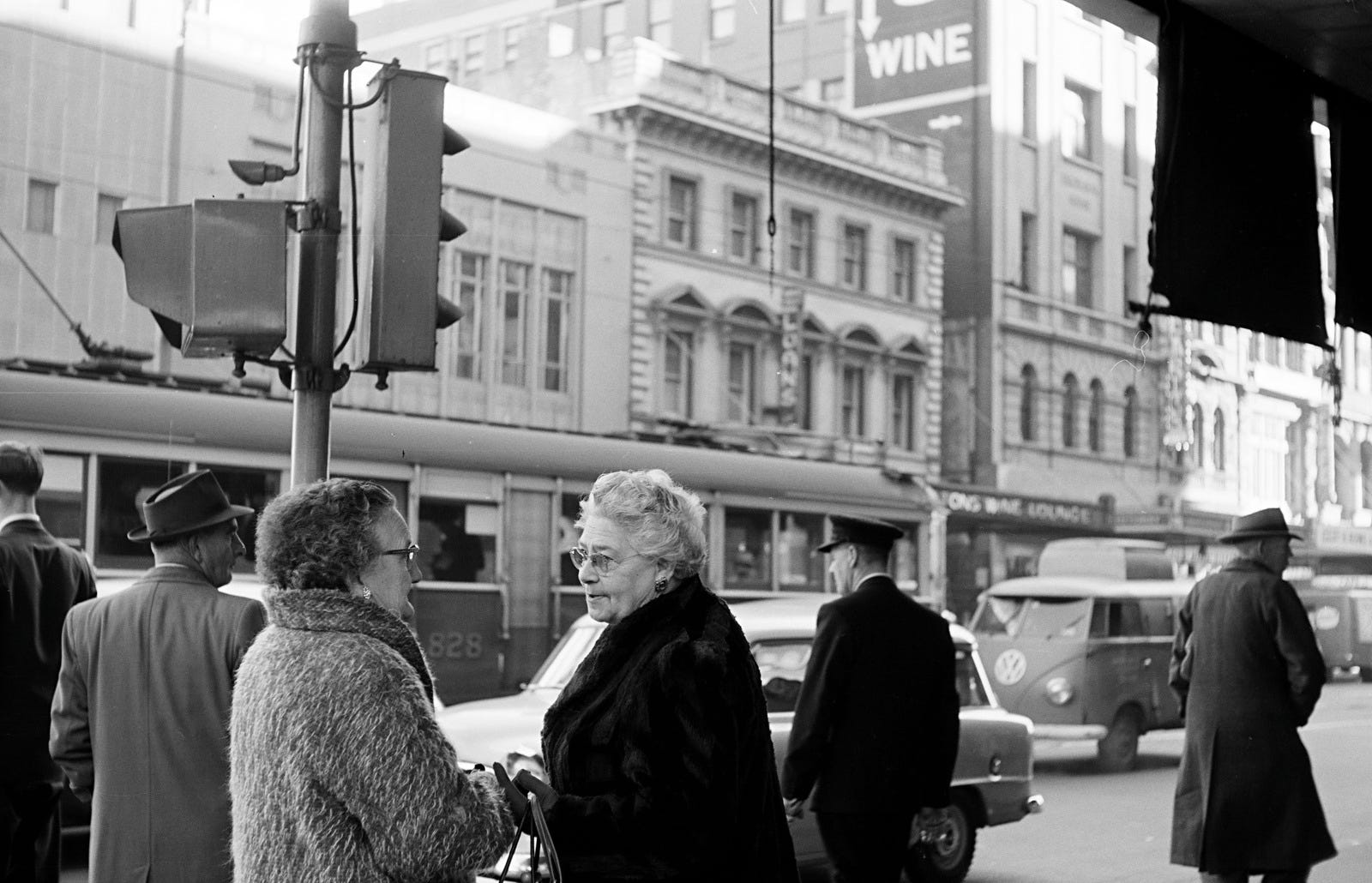
Back in the day, no one said back in the day. They said in the old days. No one said knock yourself out; they said go for your life. No one thought to push back or reach out or lean in, let alone hold space. No one said Totally or Literally or A hundred per cent. They said, I’ll say, or Too right. A few even said Bloody oath!
We no longer say skite or skew-whiff or like billy-o, more’s the pity. Skint survives by the skin of its teeth, as does Crikey! Have a crack has lasted, but not Give it a burl. The young, though, have gifted us random as a noun, to verse as a verb, hectic for wild or cool, and to hate on, a milder and more performative form of hostility than hate: Don’t hate on me!
What follows is a sketch for a longer piece I plan to write some time about how Australian language has changed over my lifetime (I’m 64). Since nearly every reader on this substack is Australian, I’m interested to hear your thoughts about differences you see in the way we talk, and whether the ideas and examples here ring true. Talking about words is fun but more than that, understanding how our language has changed is a way to understand how our country has changed.
Some shifts I see are a move from British- to American-sourced words and phrases, and from concrete to abstract language. The constant drive towards compression in speech sits alongside an increased concern with politeness and getting along that may be related to changes in male and female roles and positions over the past 50 years.
The language I knew, growing up in the 1960s and ‘70s, had a brevity and bluntness that seemed to come out of a masculine culture. The word, right, had a wide range of uses: not only too right but I’m right, which didn’t mean I’m correct but I’m satisfied or OK. If a man bumped into you and apologised, you’d say, You’re right, mate – I still say that. And people really did (and still do) say She’ll be right -- though outside of a Barry McKenzie movie I’ve never heard anyone say Bonzer! or Strewth! or Stone the crows!
I learnt all these uses of right from my father, who grew up in a country town and retained some of its language. A good thing was beaut. A punch on the leg was a cork and one on the arm a bocker, a word I’ve never heard anyone else use. He would warn his three boys by saying, You’ll know all about it, as in: If you go swimming and get eaten by a shark you’ll know all about it, even though you probably wouldn’t. And if the shark didn’t eat you but only removed a leg, at all costs you mustn’t be a sook.
British and Irish terms were still common in the old days. Trucks were lorries and trousers were daks; radio was the wireless and dinner was tea. My mother would call a bad person a rotter and they might have a row, perhaps because one of them felt they had been rooked. Replying politely but sceptically to something preposterous you wouldn’t say, Get outta here! You’d say, Get away!, or Turn it up!
Dirty was grotty and a sick kid was in the wars or crook. Pissed only meant drunk, never angry, as it does among young people now. Even in the ‘70s the use of grub or tucker for food was starting to date, but we still said that you wouldn’t miss a good movie for quids. If you did miss it you might say Rats! And if you watched it and found it confusing or even disturbing, you might say: That was a little bit different.
Horse racing terms like home and hosed were popular. A surprise was one for the books, and a stroke of luck like winning the quaddy. These terms, and cricketing ones like staying till stumps and it’s just not cricket, are all extinct or endangered, as are ockers, who have been booted off stage by bogans.
Racist terms were casually used, even by people who weren’t otherwise racist. Men spoke and wrote about women with possessive confidence – the male gaze was not yet problematic, to use a word unheard of in 1972. A newspaper columnist would write of a shapely blonde or a curvaceous brunette or -- most outrageously when seen with today’s eyes -- a pert secretary. What’s the male equivalent -- well-hung? A woman could be mannish; the use of barren to denote childless was fading, but menstruation was still the curse, a term women used, though I seem to remember it was mainly men who called a talkative woman a gas-bag.
For all that, I feel affection for the language of that time, my time, when good things were grouse, an annoying person would be told to go jump in the lake or to rack off. The past always seems simpler and more quaint than the present. Paedophiles didn’t exist but dirty old men did. No one said, I’ll grab the smashed avocado because grabbing was rude, brekky was a meal you ate at home, and no one had heard of avocado.
When I was a boy people worried about the invasion of American culture, but it was nothing compared to what was coming. Living in New York in the late 1980s I learnt Tell me about it and Go figure! and My bad. Not long after I got back to Australia these phrases were all in use. But even in the early 1990s it still felt theatrically American to end an article, as I once did, with Enjoy!
That was before the internet and 24/7 US media brought a rush of American sub-cultures in their wake: rap, hip-hop and Black American street talk, Yiddish terms from New York, tech terms from Silicon Valley, and Valley Girl slang like…like. Grouse was trampled under a stampede of American words: cool and awesome we already knew, but then came sick, bad, fresh, dope and lit, as in That party was lit (so says my daughter, what would I know?)
Americanisms have burrowed like ticks into Australian grammar. We now say different than instead of different from. We once said, She’s probably coming on Tuesday or She’s likely to come on Tuesday but never, She’s likely coming on Tuesday, yet that construction is common today. And many of us now say ‘So…’ at the start of an answer that is going to require some context and explanation, a usage reported to come from Silicon Valley computer programmers.
Language relentlessly seeks brevity and compression. It’s faster and sassier to tell someone to chill instead of take it easy, and to check this out rather than take a look at this. When I was a kid Any objections? became Any obs? but today’s young have gone further, turning Melbourne into Melbs, tomorrow into tomoz, and definitely into defs. Once a friend or former friend would have looked right through me, now she ghosted or blanked me.
In our stripped-back modern speech, the tiny word on is on a roll. We might even say it’s having a moment. Don’t worry, I’m on it. And if I screw up, that’s on me. Poor old about is one too many syllables for today’s time-poor, who want views on issues, not about them, and are no longer excited about their holiday but excited for their holiday.
Two trends run counter to these largely American-derived changes. First, words now travel in more than one direction. While in my day an excited person was stoked or psyched -- both Aussie terms -- today she might be gassed, a word from British drill music.
When my family and I lived in London in the mid-2000s many Australians visited, and, perhaps because I was away from home, I noticed how they spoke. Three phrases felt new to me: all good, sweet as and too easy. Together they evoked the good sweet ease of Australian life, seen from afar.
All good comes from ‘90s hip-hop, but sweet as is Kiwi. Too easy is Australian, but has migrated to the UK and the US. Australians also export words, a mark of our higher profile in the world. No worries, once identified only with Aussies and Kiwis, was commonly used by Brits I met, probably thanks to Neighbours. Famously, Americans now use it, too.
One thing I learnt, writing this post, is that for all their exposure to global culture, young Australians have not lost their own tongue. Flat out has flatlined (forget Flat out like a lizard drinking) but flat chat is used. Bloody might be fading, at least in the city, but kids still talk about blueing or having a blue. They still halve words in the Aussie way, still say, I’m going to uni this arvo and I think I’ll chuck a sickie from work. The shift to How ya doin’? that I thought was underway 30 years ago has stalled -- How ya goin’? is goin’ strong. And they still take the piss.
The second counter-trend to bluntness and brevity is more complex. Our language is getting softer, more facilitative. We have many phrases now to show agreement: totally, literally, seriously, defs and I know right?, not to mention the ubiquitous a hundred per cent, though absolutely is out (too posh or leisurely?).
Interview subjects in the media are always saying Great question!, which they never did before. Give your credit card details to a phone operator and she will say Purr-fect! or Amazing!, as if you had just shared your cure for cancer, shared being a new word for said. News readers say not only that someone has died but that he has tragically died. But we rarely die these days. We pass.
Language has grown kinder: spastic (once used neutrally to denote cerebral palsy before it became offensive) and retarded gave way to disabled, which yielded to living with disability. Language has also become more abstract, and so separates us from things we can see and touch. Public works – a fine old term because it explained who funded it and who it was for – became infrastructure, which people struggle to pronounce, let alone explain.
Bureaucratic documents fatten with opaque terms like diversity, equity, inclusion, intersectionality and lived experience, as if experience is ever not lived. Words like resilience and community rise as the very thing they describe falls away. Accountability and holding power to account are constantly heard, and that’s a good thing, but they also express a pessimism about the new limits of politics: no one is trying to transform the world or dreaming of a better one. When I was young the term, fair go, was actively used in conversation; now it mostly expresses an aspiration for what Australia must fight to retain.
The landscape of language is vast, differing by age, class, place and probably sex, and this sketch leaves out much. How has migration influenced our language? Computer technology? The sidelining of farm and country life, compared to a couple of generations ago? Has the structure of speech changed, or just some words? If you have thoughts, let me know in the comments section below.
What’s clear is that language is always in flux, and it gets richer and poorer at the same time, as words and phrases are gained and lost. Do youse all reckon that’s true? Yeah-nah.
Hooroo.
Thanks for a walk down memory lane. I love the way language morphs over time - words, expressions, accents - like windows into the culture of each generation.
Things were ‘ace’ as a mid north coast kid in the 70s.
My Sydney grandfather definitely had all the fair dinkum words - strewth, strike a light, Nancy boy or sissy boy and many others you mentioned.
And Australians of a certain age might come to expect violence and sex at this event.
https://events.sunshinecoast.qld.gov.au/event/34430371-a/sunshine-coast-blues-roots-festival